SkyGuardian

Passive RF Drone Detection for Critical Infrastructure

An AI-powered, edge-based detection system protecting airports, borders, and energy facilities from low-altitude drone threats in real-time.

Proven Capability

MVP complete. Tested in real RF environments. Pilot discussions active with Estonian critical infrastructure operators.

MVP Operational

Functional hardware and software complete. Ready for deployment.

Real-World Validation

Tested in RF environments with controlled drone scenarios.

Active Pilot Discussions

In discussion with Tallinn Airport and Estonian Border Guard for pilot deployments.

The Problem We Solve

The Gap: 90% of critical infrastructure lacks effective low-altitude drone detection. Traditional radar systems fail this mission: they're prohibitively expensive (€5–10M+), emit detectable signals, struggle with small slow targets, and require months to deploy.

The Solution: SkyGuardian detects unauthorized drones using passive RF monitoring combined with edge-based AI. The system operates without active emissions, making it invisible to drone operators. It detects, classifies, and localizes threats in under 2 seconds with zero cloud dependency.

Our Approach: We replace expensive, monolithic radar with a distributed, scalable mesh network of low-cost sensors (€250–300/node). Deploy in 1–2 weeks instead of 3–6 months. Cost: €10K–50K vs. €5–10M.
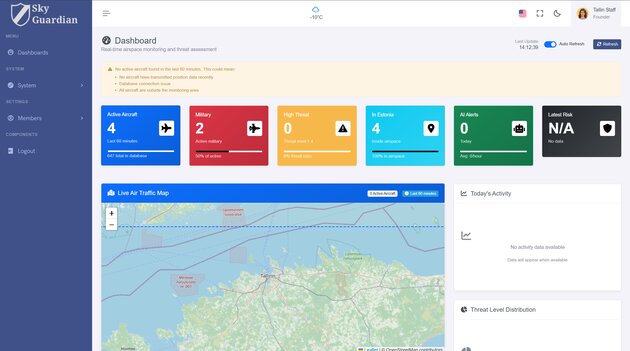

SkyGuardian Technology

Core Technical Advantages

How SkyGuardian outperforms traditional detection methods

🧠

Edge-First AI

RF signal classification runs directly on sensor hardware. Sub-2-second latency. Zero cloud dependency. Works during network outages.

🥷

Passive Detection

Zero active RF emissions. Completely invisible to drone operators. Cannot be jammed or counter-detected. Undetectable advantage.

🌐

Distributed Mesh

Scales from 3 nodes to 300+. Deploy at any site. Border perimeters, airport approaches, energy infrastructure. Decentralized, fault-tolerant.

💰

Low-Cost Deployment

€250–300 per node. €10K–50K per site. Traditional radar: €5–10M+. 100–1000x cost advantage.

Fast Deployment

Operational in 1–2 weeks. Radar systems require 3–6 months. Critical for time-sensitive security needs.

📊

Continuous Learning

ML models improve with localized data. 500+ RF signatures in training set. Performance enhances over time.

Deep Technical Specifications

Concrete performance metrics and capabilities

RF Signature Database

500+

Drone RF profiles trained and validated

Detection Latency

< 2 sec

Signal capture to threat alert

Edge AI Inference

< 50ms

Per-frame classification time

RF Coverage

433–900 MHz

Continuous passive scanning

Mesh Architecture

3 to 300+

Scalable node deployment

Hardware Cost

€250–300

Per sensor node

Business Model

Hardware deployment + recurring software subscription

Node Hardware

€250–€300

Per sensor unit. Includes RTL-SDR hardware, processing unit, and installation.

Annual License

€3,000–€8,000

Per deployment site. Includes software updates, AI model improvements, and support.

Payback Period

6–12 months

Typical installation. Gross margins on software reach 60%+ after Year 1.

Secure Your Critical Infrastructure

Discover how our deep-tech detection system can be deployed to protect your facilities.

Our Team

Deep-tech founders with signal processing, software, operations, and legal expertise

Sait Ekmekçibaşı

Sait Ekmekçibaşı

Co-Founder & CTO

Signal processing, machine learning, hardware architecture

Seray Mübarek

Seray Mübarek

Chief Legal Officer

Regulatory compliance, EU cybersecurity framework, partnerships

Barış Sırım

Barış Sırım

Co-Founder & Head of Marketing

Strategic partnerships, go-to-market, customer relations

Elif Ekmekçibaşı

Elif Ekmekçibaşı

Co-Founder & Head of Operations

Hardware integration, QA, deployment, pilot management